Nursing Goal For Ineffective Breathing Pattern
Nursing Goal For Ineffective Breathing Pattern - Web during the nurse’s first assessment and each daily assessment, the following needs to be documented: Monitor respiratory rate, ease of breathing, and depth of respiration. The average rate of respiration for adults is 10 to 20 breaths per minute. This template is particularly crucial for treating individuals with respiratory issues like copd, asthma, or those experiencing pain affecting their breathing. The long term goals are for the patient to be free of cyanosis and establish normal breathing. The aim is to help the patient achieve a regular, effective breathing pattern. Web the following are common nursing care planning goals and expected outcomes for an ineffective breathing pattern: Inflammation also breaks down surfactant making the lungs less compliant. Patient’s o saturation level has risen to a normal rate greater than or equal to 95% by end of shift. As a medical professional, you will provide nursing interventions to help alleviate the ineffective airway clearance and improve the overall function of the respiratory system. This nursing diagnosis is appropriate for patients who cannot maintain adequate oxygenation resulting in insufficient tissue perfusion and carbon dioxide removal. Include evidenced based rationales for each nursing intervention using your textbooks. Monitor respiratory rate, ease of breathing, and depth of respiration. Web ineffective breathing pattern. Web ineffective breathing pattern nursing diagnosis & care plan. Web patient to increase breathing capacity. Nurses take the lead in providing supportive interventions and. Adapt care based on oxygenation assessment data. How can nurses help a patient with an ineffective breathing pattern? Pneumothorax or collapsed lung is caused by air leaking into the pleural cavity. Patient will maintain a patent airway as evidenced by clear breath sounds, oxygen saturation within normal limits, and the ability to cough to clear secretions. It is important to take action when respirations exceed 30 breaths per minute. Web auscultate breath sounds at least every 4 hours to detect decreased or adventitious breath sounds; When the breathing pattern is ineffective,. Web during the nurse’s first assessment and each daily assessment, the following needs to be documented: The average rate of respiration for adults is 10 to 20 breaths per minute. When the breathing pattern is ineffective, the body will likely not get enough oxygen in the cells. The disease process of ards is broken down into three stages: Inflammation also. Web during the nurse’s first assessment and each daily assessment, the following needs to be documented: Monitor respiratory rate, ease of breathing, and depth of respiration. How can nurses help a patient with an ineffective breathing pattern? The disease process of ards is broken down into three stages: Web ineffective breathing pattern care plan: Interpret diagnostic tests and lab values indicative of a disturbance in oxygenation. The disease process of ards is broken down into three stages: Patient demonstrates a baseline respiratory rate,. It is important to take action when respirations exceed 30 breaths per minute. Web ineffective breathing pattern. The disease process of ards is broken down into three stages: Monitor respiratory rate, ease of breathing, and depth of respiration. The average rate of respiration for adults is 10 to 20 breaths per minute. This includes reducing the respiratory rate, promoting deep and efficient breaths, and minimizing the use of accessory muscles for breathing. When lung tissues are injured,. Adapt care based on oxygenation assessment data. Web irregular breathing (hyperventilating), nasal flaring, mouth breathing, gasping for air, and use of accessory muscles are symptoms of an ineffective breathing pattern that require immediate attention. Web the short term goals are for the patient to understand their treatment and demonstrate proper breathing techniques to alleviate symptoms. A logistic regression was fitted. Web ineffective breathing pattern. When lung tissues are injured, the alveoli become permeable to large molecules, allowing more proteins, debris, and fluids to enter lungs. Web improved breathing pattern: It is important to take action when respirations exceed 30 breaths per minute. Maegan wagner, bsn, rn, ccm. Patient will deny shortness of breath. Nurses take the lead in providing supportive interventions and. Nursing diagnoses, care plans, assessment & interventions. Patient will maintain an effective breathing pattern with normal respiratory rate, depth, and oxygen saturation. This template is particularly crucial for treating individuals with respiratory issues like copd, asthma, or those experiencing pain affecting their breathing. Web the short term goals are for the patient to understand their treatment and demonstrate proper breathing techniques to alleviate symptoms. A logistic regression was fitted to assess the simultaneous effects of related factors. Nurses take the lead in providing supportive interventions and. Web ineffective breathing pattern. Web auscultate breath sounds at least every 4 hours to detect decreased or. Discuss the role of the nurse in the management of ards. Web ineffective breathing patterns can happen in various situations, but they are always dangerous for patients’ health. Web the short term goals are for the patient to understand their treatment and demonstrate proper breathing techniques to alleviate symptoms. State whether or not the goal was met. Web patient to. Web the short term goals are for the patient to understand their treatment and demonstrate proper breathing techniques to alleviate symptoms. Web irregular breathing (hyperventilating), nasal flaring, mouth breathing, gasping for air, and use of accessory muscles are symptoms of an ineffective breathing pattern that require immediate attention. It is important to take action when respirations exceed 30 breaths per minute. Assess the patient for objective and subjective manifestations of impaired oxygenation. Web ineffective breathing patterns can happen in various situations, but they are always dangerous for patients’ health. Web an ineffective breathing pattern nursing care plan template is essential for nurses and healthcare professionals to manage conditions impairing patients' breathing. When lung tissues are injured, the alveoli become permeable to large molecules, allowing more proteins, debris, and fluids to enter lungs. Patient will deny shortness of breath. The aim is to help the patient achieve a regular, effective breathing pattern. This includes reducing the respiratory rate, promoting deep and efficient breaths, and minimizing the use of accessory muscles for breathing. To identify the predicting factors and sensitivity, specificity, positive and negative related value of nursing diagnosis ineffective breathing pattern among patients of an intensive care unit. Nursing diagnoses, care plans, assessment & interventions. Include evidenced based rationales for each nursing intervention using your textbooks. The long term goals are for the patient to be free of cyanosis and establish normal breathing. In a normal lung, negative pressure exists between the visceral and parietal pleura or the pleural space. The disease process of ards is broken down into three stages:
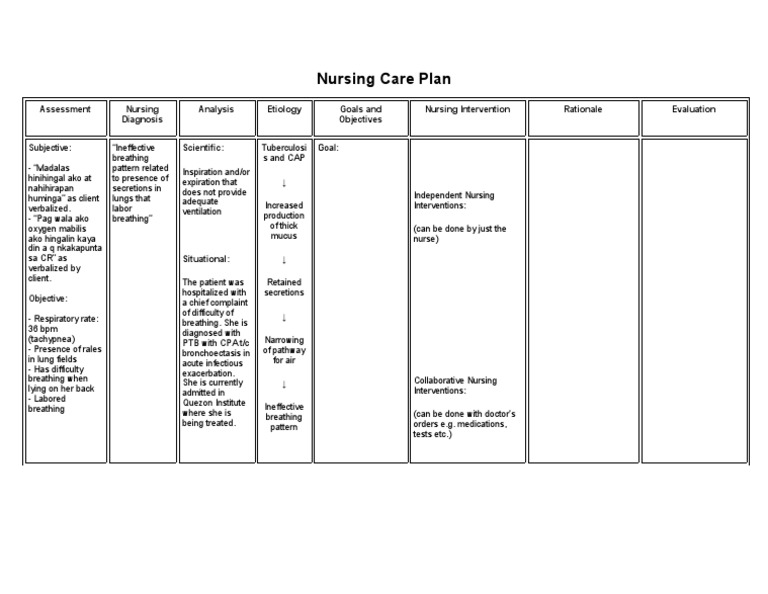
Nursing Care Plan Ineffective Breathing Pattern

SOLUTION Nursing care plan ineffective breathing pattern related to
Ineffective Breathing Pattern Nursing Care Plan
Nursing Care Plan (Ineffective Breathing Pattern) Anxiety Applied
NCP Ineffective Breathing Pattern Tala
Ineffective Breathing Pattern Nursing Diagnosis and Nursing Care Plan
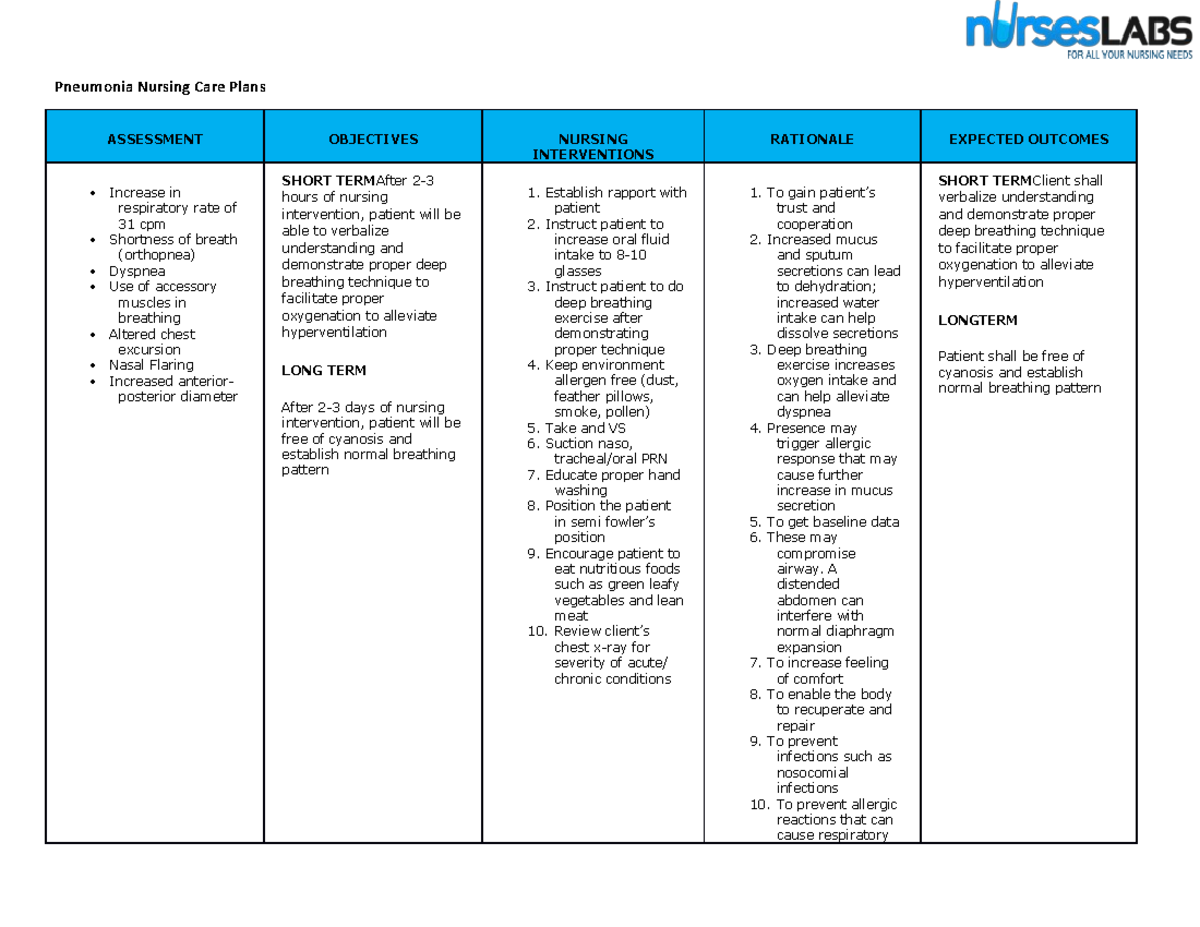
117006719 Ineffective Breathing Pattern Pneumonia Nursing Care Plan

Nursing Care Plan Ineffective Breathing Pattern

Ineffective Breathing Pattern Nursing Care Plan

SOLUTION Nursing care plan ineffective breathing pattern poliomyelitis
Web Summarize The Treatment Of Ards.
Web Ineffective Breathing Pattern.
Patient Will Maintain A Patent Airway As Evidenced By Clear Breath Sounds, Oxygen Saturation Within Normal Limits, And The Ability To Cough To Clear Secretions.
Nurses Take The Lead In Providing Supportive Interventions And.
Related Post: